On Wednesday, after six days of deliberation, jurors
convicted former New England Patriots star
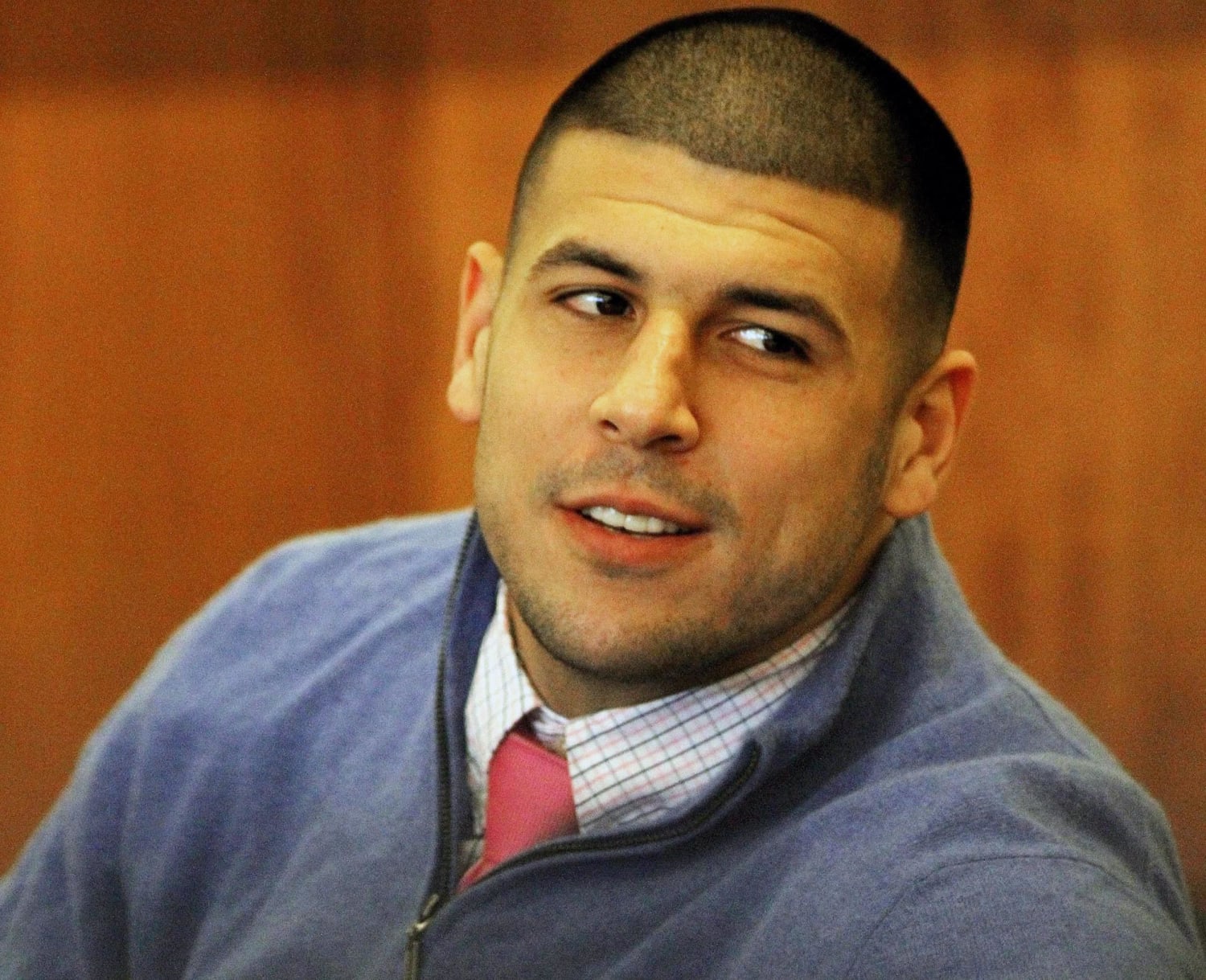
The verdict followed a nine-week trial in which Bristol
County (Mass.) called 131 witnesses and introduced more than 430 exhibits in
its case-in-chief to prove that Hernandez was responsible for the murder of
Odin Lloyd in an industrial park a mile from Hernandez’s home in North
Attleboro (Mass.). Hernandez was accused of joining co-defendants Ernest
Wallace and Carlos Ortiz in picking up Lloyd at his Boston home early on
Monday, June 17, 2013, and then driving Lloyd to the industrial park, where he
was executed.
• MCCANN: Day-by-day coverage of Aaron Hernandez's murder
trial
The verdict is an enormous victory for the Bristol County
District Attorney’s Office and in particular lead prosecutor William McCauley.
Along with assistant district attorney Phillip Bomberg, McCauley convinced
jurors that Hernandez murdered Lloyd in spite of the absence of a murder weapon
or a cooperating eyewitness. Jurors were also not presented with a compelling
motive as to why Hernandez would have killed Lloyd, but as noted throughout the
trial, motive is not a required element of murder.
For Hernandez’s attorneys—James Sultan, Michael Fee and
Charles Rankin—the first-degree murder conviction surely comes as a stunning
disappointment. As explained below, they will wage an appeal.
Why jurors convicted Hernandez
The conviction reflects the clear evidence that Hernandez
played a role in Lloyd’s murder—especially the cover-up that involved
Hernandez’s fiancée, Shayanna Jenkins. In his closing argument, McCauley also
raised effective points about Hernandez’s involvement with the murder by
highlighting how Hernandez housed, fed and financed co-defendants Ernest
Wallace and Carlos Ortiz. If Hernandez was angered or surprised by Wallace or
Ortiz shooting Lloyd, Hernandez arguably didn’t act that way following Lloyd’s
murder. This probably played a role in jurors voting to convict Hernandez.
Those jurors were likely also persuaded by suspicious text
messages sent by Hernandez to Lloyd prior to Lloyd’s murder as well as Hernandez’s
efforts to buy firearms. McCauley’s memorable line in his closing argument to
jurors that Lloyd was killed in “an efficient” manner—“boom, boom, boom, boom,
boom, boom”—also helped to convince jurors of the “extreme cruelty and
atrocity” in Lloyd’s murder. In fact, during jurors’ post-verdict press
conference, one juror suggested that the jury disagreed on whether Hernandez
planned the murder. That same juror, however, indicated that all of the jurors
agreed that the manner of Lloyd’s murder constituted extreme cruelty: “the
shots—there were six of them—that was extreme.” This is important because under
Massachusetts law, a first degree murder conviction can be based on extreme
cruelty and atrocity in carrying out an intentional murder.
McCauley placing Hernandez as the shooter through ballistics
and footwear impression evidence also likely resonated with jurors. During the
post-verdict press conference, several jurors found a .22-caliber gun found
near Lloyd’s body particularly significant. This gun was connected to Hernandez
through evidence showing that he purchased it from Oscar “Papoo” Hernandez (no
relation) in Florida.
As discussed throughout the trial, Massachusetts joint
venture law played a crucial role in how jurors assessed the evidence and
witness testimony. During the post-verdict press conference, jurors did not
express certainty that Hernandez was the shooter. Hernandez, however, didn’t
need to be the shooter in order to be convicted of murder. Jurors could convict
him so long as they were convinced of three points: (1) Hernandez was at the
crime scene; (2) he shared the intent to see Lloyd murdered and (3) he
significantly contributed to the murder. Hernandez was clearly at the crime
scene—his defense team admitted that—and he clearly contributed to the murder
by driving Lloyd, buying gas and apparently buying firearms used to kill Lloyd.
The more debatable question was whether Hernandez shared the intent to kill
Lloyd. After six days of deliberating, and perhaps some debate, jurors agreed
Hernandez did share the intent to kill Lloyd.
The defense’s controversial decision to place Hernandez at
the murder scene
During his closing argument, Sultan admitted that Hernandez
was at the crime scene when Lloyd was killed. Sultan then described Hernandez
as a 23-year-old who simply panicked after watching someone he knew—Wallace or
Ortiz—kill another person. This was a controversial move by the defense since
it eliminated any juror doubt about Hernandez being at the crime scene. It also
assured the prosecution that at least one of the three prongs for convicting
Hernandez on joint venture murder was satisfied.
Why did the defense employ this strategy?
First, there was already undeniable evidence of Hernandez
being at the crime scene. Hernandez’s footwear impressions, tire tracks of a
car he rented and a marijuana blunt with his DNA were all found near Lloyd’s
body. In addition, surveillance video showed Hernandez driving a car with
Wallace and Ortiz as passengers and that car would pick up Lloyd. It would have
required gymnastics of basic logic for the jury to conclude Hernandez was not
at the crime scene. Hernandez’s legal team probably concluded the jury would
not have engaged in that kind of thinking. Then again, during the jury’s
post-verdict press conference, one juror opined the jury “was shocked” at
Sultan’s admission. It’s unclear if the juror was shocked that Sultan would
have made the admission or if the juror was shocked Hernandez was at the crime
scene.
NFL
Mysterious box crucial in Hernandez's fiancee's testimony on
Monday
by Michael McCann Second, most of the evidence implicating
Hernandez took place after Lloyd’s murder. Recall Jenkins’s testimony. Within a
day of the murder, Hernandez directed Jenkins to give Wallace $500—presumably
to help Wallace flee to Florida—and Hernandez asked Jenkins to remove a highly
suspicious box from the basement. Hernandez was also caught on surveillance
video minutes after the murder walking around his house with what looked like a
Glock gun. Jurors were thus provided with plenty of reasons to infer from
Hernandez’s post-murder behavior that he was the shooter or shared the intent
of the shooter to kill Lloyd. But by essentially admitting that Hernandez
participated in a cover-up, Sultan tried to direct jurors away from making that
inference. Instead, he framed the post-murder evidence as evidence of covering
up a friend’s murder.
Clearly, the move failed. Jurors either didn’t buy it or
found sufficient pre-murder evidence against Hernandez. That evidence included
Hernandez possibly holding a Glock gun in Miami and Hernandez’s texts to Lloyd.
Why the separate sentencing for firearms matters
Hernandez was also convicted of two firearm charges:
unlawful possession of a firearm, which carries a potential penalty range of
1.5 years to 5 years, and unlawful possession of ammunition, which carries a
penalty of up to two years. Judge Garsh sentenced Hernandez to 3.5 years of
prison. While the 3.5-year sentence may seem inconsequential given that
Hernandez also received a life sentence with no opportunity for parole, it
could nonetheless prove very important if Hernandez’s attorneys successfully
appeal the conviction.
Jurors are free to talk
As expected, Judge Garsh did not issue a gag order that
would prevented jurors in the Lloyd trial from talking about their jury
service. The absence of a gag order enabled jurors to hold a post-verdict press
conference in which they discussed their reasoning for convicting Hernandez.
It will be interesting to watch if any jurors speak
individually with media or express points through social media. The fact jurors
took six days to render a verdict could reflect the substantial amount of
evidence they had to pour over—or signal that they might have debated between
first and second degree murder. For purposes of appeal, Hernandez’s attorneys
will surely be monitoring jurors’ comments to see if they indicate they were
confused about the law or how to apply it. Also for purposes of appeal,
Hernandez’s attorneys will gauge whether jurors reveal they were impacted by
media attention of the trial.
Hernandez will appeal verdict
As is his constitutional right and automatic procedure under
Massachusetts law, Hernandez will appeal the murder conviction. The appeals
process starts immediately. Hernandez’s attorneys have likely already begun
work on drafting an appeal that will be heard by the Massachusetts Supreme
Judicial Court (“SJC”). Do not expect a quick resolution, as appeals often take
many months and sometimes years. Hernandez will remain incarcerated as he
awaits the resolution of his appeal.
It should be noted that most appeals fail. Data indicates
reversals occur in only about 10% of appeals. On the other hand, two of
Hernandez’s attorneys, James Sultan and Charles Rankin, are regarded as among
the best attorneys in Massachusetts for post-conviction appeals. This is most
notably true for murder convictions. A few years ago, for example, Sultan and
Rankin persuaded the SJC to overturn the conviction of a woman who had
allegedly confessed to a murder on grounds the confession was improperly
obtained. Sultan and Rankin will look to continue their success with
Hernandez’s appeal.
In an appeal, Hernandez’s attorneys will not argue that “the
jury got it wrong,” as that would not serve as a viable appellate argument.
Similarly, Hernandez’s attorneys will not demand that the appellate court
reconsider evidence or the believability of witness testimony, as an appeal is
not a retrial.
An appeal instead concerns possible errors made by the judge
in interpreting and applying the law. Along those lines, Hernandez’s attorneys
will contend that various decisions made by Judge Garsh were erroneous and
constituted “errors of law.” Judge Garsh, Hernandez’s attorneys will insist,
mistakenly allowed jurors to see certain pieces of evidence or hear segments of
witness testimony. Hernandez's attorneys might, for instance, highlight Judge
Garsh permitting Glock employee Kyle Aspinwall—who acknowledged that he was not
an expert on video analysis—to offer opinions about surveillance video of
Hernandez holding an object in his home minutes after Lloyd's murder. Aspinwall
testified that he thought Hernandez was holding a Glock pistol, which was the
type of gun used to murder Lloyd. While Judge Garsh limited the admissible
scope of Aspinwall's testimony, she permitted jurors to consider some of what
he said.
Jury instructions at the end of the trial are also a common
source of appeal—and watch for Hernandez’s attorneys to scrutinize statements
made by jurors in their post-verdict press conference to see if any jurors
signaled they didn’t correctly understand or apply the law. More unique to
Hernandez, watch for his attorneys to contend that media coverage influenced
the jury and should have led Judge Garsh to declare a mistrial. Last Thursday,
Judge Garsh banned a Boston television station photographer after he admitted
to following jurors in his station’s SUV to a parking lot. Judge Garsh also
warned other media that approaching jurors would trigger a similar penalty. If
jurors indicate media attention influenced the verdict, Hernandez’s attorneys
will surely take note.
In an appeal, Hernandez’s attorneys will also need to
portray the alleged mistakes as meaningful in the outcome to the trial. Not
every mistake by a trial judge warrants a reversal. Most mistakes, in fact, are considered
relatively minor or lacking the necessary impact to disregard a unanimous
guilty verdict by jurors.
In short, the odds are against Hernandez succeeding in an
appeal, but he has hired the right legal team to nudge those odds significantly
higher than are odds experienced by most appellants.
We may learn more about Lloyd’s murder in upcoming trials of
co-defendants Ernest Wallace and Carlos Ortiz—and Hernandez could testify in
those trials
As was his right under the Fifth Amendment to the U.S.
Constitution, Hernandez did not testify in his own trial. This was not
surprising, as defendants in murder trials usually do not testify. With the
unfair benefit of hindsight, perhaps Hernandez should have testified in his own
defense. It would have been an extremely controversial move, however, and if
Hernandez was later convicted the decision to call him to the stand would have
been second-guessed for years to come.
Hernandez might have another opportunity to testify about
Lloyd’s murder. His co-defendants face future trials for Lloyd’s murder. Hernandez
cannot be forced to testify in those trials for several reasons, including that
his appeal will secure his Fifth Amendment rights to avoid self-incrimination.
It also seems unlikely that Hernandez, whom reportedly places a high value on
loyalty, would volunteer to testify to implicate his co-defendants. Still, it
is plausible Hernandez could testify. He might do so in hopes that if his
appeal on the Lloyd murder conviction succeeds and he is retried for Lloyd’s
murder, Hernandez could then better argue that Wallace and Ortiz were to blame.
Hernandez still faces another murder trial
Hernandez’s “other” murder trial may at first glance seem
irrelevant given his conviction in the murder of Lloyd, but as noted above,
Hernandez will attempt to have the conviction reversed on appeal. The
possibility of a successful appeal maintains significance in the other trial.
Hernandez is accused with murdering Daniel de Abreu and Safiro Furtado outside
the Boston nightclub Cure on July 12, 2012. While the deaths of de Abreu and
Furtado occurred a year before Lloyd’s death, Hernandez went to trial first for
Lloyd’s death because he was charged first with Lloyd’s death (Hernandez was
charged with murdering Lloyd on June 26, 2013, and he was charged with
murdering de Abreu and Furtado on May 15, 2014). Had prosecutors in Suffolk
County (Mass.) and Bristol County (Mass.) tried to prosecute Hernandez first
for de Abreu and Furtado, Hernandez’s attorneys were prepared to argue
Hernandez’s right to a speedy trial under the Sixth Amendment to the U.S.
Constitution and under Massachusetts law would be violated.
The murder trial in Boston was originally scheduled for May
2015, but the date has been put on hold pending the outcome of the Lloyd murder
trial. Whenever the Boston trial occurs, Hernandez will be accused of driving a
silver Toyota 4Runner slowly around the Cure nightclub at 2 a.m. with Alexander
Bradley—a government witness in the Lloyd murder trial and a plaintiff in a
lawsuit against Hernandez for allegedly shooting him in the face outside a
Miami strip club in Feb. 2013—as a passenger. Hernandez, according to the
prosecution’s theory, sought to execute de Abreu who while dancing spilled a
drink on Hernandez in the nightclub earlier in the evening and allegedly failed
to apologize to Hernandez. Prosecutors contend Hernandez waited for de Abreu
and friends to enter a BMW and then, in a drive by-style shooting, opened fire
on de Abreu, Furtado and Aquilino Freire, who was shot in both arms but
survived. There is reportedly surveillance video of Hernandez and Bradley in
the car, and the murder weapon has supposedly been found as well.
It remains to be seen how strong the evidence holds up.
Clarity of video was a challenge for the prosecution in the Lloyd trial, and an
eyewitness description of the Boston shooter as a “light skinned Hispanic man
with short hair” matches up with numerous people in Boston that night and not
only Hernandez.
Some have speculated that Lloyd’s murder was due to Lloyd
revealing to others that Hernandez shot de Abreu and Furtado. This alleged
revelation may have occurred while Lloyd was at the Rumor nightclub in Boston
with Hernandez on June 15, 2013. Hernandez, according to testimony by Lloyd
friend Kwami Nicholas during Lloyd’s trial, “stared down” Lloyd at Rumor. To be
clear, any link between Lloyd’s murder and the murders of de Abreu and Furtado
remains unproven.
Hernandez faces civil litigation—and may have to testify in
a trial
Now that a jury has convicted Hernandez of Lloyd’s murder,
he will surely face a wrongful death lawsuit over Lloyd’s death (a wrongful
death lawsuit would have been filed regardless of the verdict). In the
prosecution, jurors were convinced beyond a reasonable doubt of Hernandez’s
guilt. There is no percentage of certainty for “beyond a reasonable doubt,”
since “reasonable doubt” centers on the jury assessing the reasonableness of
various doubts raised by the defense during the trial. That said, jurors were
firmly convinced of Hernandez’s guilt or they would have not convicted him.
Civil lawsuits, in contrast, only require the jury find a
preponderance of evidence of fault. This essentially means the jurors must
conclude it is “more likely than not” or “anything higher than 50%” that the
defendant is liable. Also, in Massachusetts, only a majority of jurors need to
find fault in a civil trial—unlike the unanimous jury requirement in a criminal
trial. This is a much lower threshold to find Hernandez at fault.
Lloyd’s family will argue Hernandez’s negligence caused Lloyd’s
death and that Hernandez owes the Lloyd family millions of dollars for the
death. The criminal verdict makes it a virtual certainty that Hernandez acted
unreasonably and that his unreasonable conduct contributed to Lloyd’s death.
The evidence includes, but is not limited to, evidence of Hernandez buying
firearms, driving Lloyd to the crime scene and then trying to cover-up the
crime.
Hernandez also faces a wrongful death lawsuit brought by the
families of de Abreu and Furtado, whom, as discussed above, Hernandez has been
charged with murdering in Boston three years ago. This wrongful death lawsuit
will be litigated after the Boston murder trial. The families already had an important pretrial ruling in
2014 when Suffolk (Mass.) Superior Court judge Bonnie McLeod placed a $5
million lien against real estate owned by Hernandez. Hernandez’s 7,100 square
foot home on 22 Ronald C. Meyer Driver in North Attleboro (Mass.) is valued at
between $1.2 million and $1.5 million.
Safe to say, Hernandez will be meeting with lawyers for some
time to come. Families of the men Hernandez has allegedly killed can also call
Hernandez to testify in any civil trials. Defendants in civil trials can invoke
the Fifth Amendment right against self-incrimination until final conviction,
which means after appeals have been exhausted. Hernandez will likely invoke his
Fifth Amendment right during any civil trials, provided those civil matters are
litigated while he appeals his conviction in Lloyd's murder and while he
defends himself in the Boston murder trial. A judge in a civil trial, it should
be noted, could instruct jurors that they can infer Hernandez's testimony would
have been harmful to him if he had not invoked his Fifth Amendment right.
Wrongful death lawsuits are often resolved out-of-court
through settlements, but wrongful death lawsuits sometimes go to trial. This
occurred after a jury found O.J. Simpson not guilty for the crime of murdering
his wife, Nicole Brown Simpson, and Ronald Goldman. A jury in a subsequent
wrongful death lawsuit brought by the Brown and Goldman families found Simpson
liable for wrongful death and owing $33.5 million in damages.